A Masonic Tribute to America's Veterans
In the dead of night during the Civil War, something remarkable happened along the front lines: Union and Confederate soldiers, enemies by day, would lay down their weapons, cross into no man’s land, and sit together as Brothers. Not because the war had ended, but because many of them had first put on a different kind of uniform: the apron of a Freemason.
Nearly a century and a half later, that same thread of belonging, trust, and shared values still runs through the long history connecting Freemasonry and American military service. This Veterans Day, we’re sharing remarks delivered this year by RWB Franklin E. Cline, Grand Secretary of the Grand Lodge of Illinois A.F. & A.M., at the dedication of a veterans campus in the Chicagoland area. In his address, Brother Cline traces that legacy from the earliest colonial lodges through the generals, decorated heroes, and countless lodge Brothers who have worn their country’s uniform.
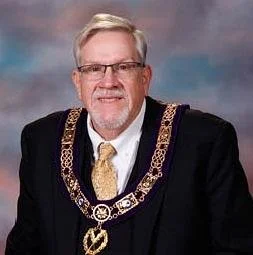
Right Worshipful Brother Frank Cline
MASONIC DEDICATION TRIBUTE TO OUR FOUNDING FATHERS
By RWB Franklin E. Cline, Grand Secretary
Prominent Freemasons are well known for their involvement in the American Revolutionary War. Some of these stories are fact, some are fiction. Some stories portray Freemasons such as George Washington and John Paul Jones as war heroes; others portray men such as Benedict Arnold, whom George Washington placed in command of West Point, as a traitor to this country and a hero in Great Britain. The Revolutionary War was not started by Masonic Lodges, but by members acting as individuals based on their own beliefs and survival instincts.
Seventy-two years before the Declaration of Independence was signed, the first known Freemason in what would become the United States of America had already been born on this soil. Jonathan Belcher, born in Boston, later became the Colonial Governor of Massachusetts and New Hampshire. He became a Freemason while visiting Europe in 1704 before returning home to Boston in 1705. Other men who later traveled to Europe, as well as British soldiers, brought more Freemasonry to this country.
The first recognized Masonic Lodge was chartered in Boston, Massachusetts, on July 30th, 1733. There were also small groups of Freemasons trying to form lodges across New England and Pennsylvania as early as 1720.
The reason I give this history is to show how long some of these Freemasons could have known and trusted, or not trusted, each other. When the time came, and the citizens grew weary of British laws, sanctions, and taxes, these men knew who shared their opinions. By knowing them, they knew who had militia and military skills, finances, necessary equipment and supplies, as well as transportation equipment and knowledge. We do not talk about religion or politics during a titled meeting of the lodge, though discussions before or following a meeting are not restricted. It has been suggested that in various taverns where these Masons socialized with non-Masons, many of the frustrations of the day were discussed.
Masons, being taught leadership skills and following a plan within the lodge, may have been viewed as good leaders and were placed in prominent positions within the revolution.
As part of our Installation Ceremony, a portion of which was directly influenced by the Revolutionary War and written by Paul Revere, we as Masons vow: “As a citizen, he should be loyal to his government, obedient to its laws, prompt in the duties he owes to society, and a pattern of fidelity in all social and domestic relations.”
The Prince Hall Affiliation of Freemasons was established in 1775. It started in part because of the Revolutionary War and in part because abolitionist Mr. Prince Hall and 14 other free Black men petitioned for membership in St. John’s Lodge at Boston, but were rejected. British Freemasons learned of these rejections and, as a result, invited the 15 men to join their British Military Lodge. The soldiers took these men by boat, under the cover of darkness, onto the British warships and initiated, passed, and raised them in the degrees of Masonry.
The British then tried to convince them to help undermine the American Revolution. These newly made Masons, being men of good character and wanting the same relief from British laws, sanctions and taxes, did not see fit to work for the British who they felt misled them.
Many Freemasons have, and still do, serve in the military. They share many of the same beliefs: camaraderie, loyalty, and integrity. Veterans are drawn to Masonry the same way they are drawn to organizations such as the VFW, AMVETS, and American Legion. Masonry does its best to keep men as involved as they choose, to share the same camaraderie they enjoyed in the military, and to give them a place to enjoy friendships, visit, and feel wanted, needed, and supported. Masonry provides this safe harbor in part with the hope that it will help to prevent depression or more tragic mental health-related issues.
In the 18th, 19th, and 20th centuries, military or "traveling" lodges were chartered by Grand Lodges specifically for regiments from their States. These lodges moved with the troops, allowing soldiers to hold Masonic meetings, perform ceremonies, and initiate new members during deployments. While traveling lodges have faded in the U.S., Prince Hall Military Lodges historically continued the tradition, particularly overseas and on U.S. Military Bases.
Freemasons such as Paul Revere, John Hancock, Joseph Warren, and Benjamin Franklin advised Thomas Jefferson, who was not a Mason, as he drafted the Declaration of Independence, using concepts that parallel Masonic beliefs on a person’s rights and ability to govern themselves.
Among the delegates signing the U.S. Constitution, 9 of the men at the Constitutional Convention are confirmed Freemasons, including Benjamin Franklin, George Washington, and John Hancock. The structure, as well as the checks and balances found in the Articles of Confederation and the Constitution of the United States, was very similar to the organizational frameworks of Masonic constitutions.
Many military Veterans celebrated in history were Freemasons, finding that the lodge's values aligned with their own. Among them were:
John Paul Jones – American Revolutionary War – the “Father of the American Navy.”
Matthew Fontaine Maury – American Civil War – the “Pathfinder of the Seas.”
General John A. Lejeune – Spanish-American War through WWI – a commander of the U.S. Army 2nd Division, and Major General in the Marine Corps.
General George Washington – The French & Indian War and the American Revolutionary War – “The Father of our country,” and first President.
General John J. Pershing – WWI – led the extraordinary American forces on the Western Front.
Eddie Rickenbacker – WWI – Flying Ace, Medal of Honor recipient, and aviation pioneer.
General James “Jimmy” Doolittle – WWI and WWII – pioneer of aeronautics.
General Douglas MacArthur – WWI, WWII, and the Korea Conflict – 5-Star General and Medal of Honor recipient
General George C. Marshall – WWI, WWII, and the Korea Conflict – served as Army Chief of Staff during WW2 and authored the Marshall Plan.
General Omar Bradley – WWI, WWII, and the Korea Conflict – 5-Star General who commanded the 12th Army Group in Europe.
Enoch “Woody” Woodhouse – WWII – decorated Hero of the Tuskegee Airmen.
Audie Murphy – WWII – the most highly decorated American combat soldier in U.S. History.
Thomas Moe – Vietnam and the Gulf War – flew 85 combat missions in Vietnam before spending 1,881 days as a prisoner of war in the brutal “Hanoi Hilton”.
Freemasonry also played a key role in the American Civil War. Thousands of soldiers and officers on both sides were members of the fraternity. They often used a Masonic distress signal to request aid, protect property, or offer treatment for captured or wounded Masons serving in the other camp. When the war stopped at night, Masons from both sides would lay down their arms, cross enemy lines, and meet as members of the Masonic Fraternity.
Located at the Gettysburg National Military Park, the Friend to Friend statue commemorates an instance where Union Captain Henry Bingham, a Mason, provided aid to his dying friend and brother, Confederate General Lewis Armistead. This is the only known Masonic statue ever allowed on government property.
During the war, over 50,000 Freemasons spent time in military prisoner-of-war camps. The fraternal connections worked as a lifeline, providing much-needed moral and physical treatment in inhospitable conditions.
Due to the respect and assistance the non-Masons witnessed, many of these men joined lodges when they returned home. As much as we dislike war and the loss of lives, membership growth always happened during wartime.
Active-duty service members and veterans continue to join local lodges near their duty stations. Masons in the military can also join organizations like the National Sojourners, a fraternity exclusively for Master Masons who are or have been Warrant or Commissioned Officers in the U.S. uniformed services.
As we dedicate this Chicagoland Veterans Campus, honoring American bravery and serving American Veterans, let us remember with pride both the veterans who returned home and the brave men and women who gave their lives protecting the lives of their families and friends at home. They will not be forgotten.